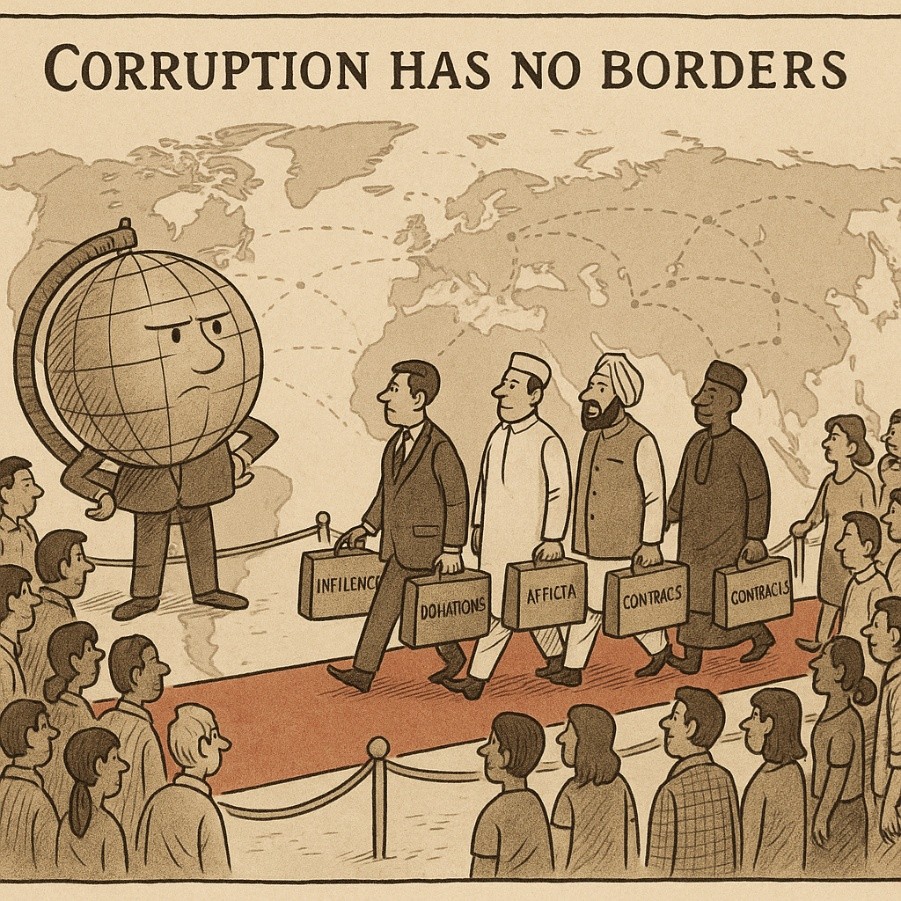

Corruption no longer ends political careers — it negotiates them.
By Ravishankar Kalyanasundaram
Benjamin Netanyahu’s request for a presidential pardon has jolted Israel’s political landscape. On trial for bribery, fraud and breach of trust, the country’s longest-serving prime minister now asks to be exempted from the very judicial process that governs every other citizen. The argument offered by his camp is familiar across democracies: that leadership must not be distracted by litigation and that clemency would help the nation move on. The counter-argument is just as familiar: when leaders secure immunity before accountability, the rule of law becomes theatre.
But the real significance of this moment goes beyond Israel. It reflects a deeper trend that has been building across the world for more than a decade — corruption at the highest levels is no longer fatal to political careers. In many countries, it has become a tool of polarisation, a rallying cry, even a badge of persecution that strengthens support rather than erodes it. Political scandals once triggered resignations, remorse and reform. Today they trigger rallies, hashtags and fund-raising campaigns. Instead of shame, we see defiance. Instead of retreat, we see consolidation of power.
The story repeats itself across continents. Brazil’s Lava Jato case peeled back a vast network of kickbacks connecting state enterprises and contractors to ministers and presidents, exposing a cycle of enrichment built into public procurement. In Brussels, allegations that foreign governments bought influence within the European Parliament revealed how even the most institutionalised democracies are vulnerable when transparency becomes complacency. In Asia and Africa, corruption is often explained away with the language of “strong leadership” or “stability”, even when public money meant for schools or hospitals ends up in private fortunes. People become used to navigating around corruption rather than resisting it; it ceases to shock, and once it ceases to shock, it ceases to threaten power.
The survival strategy follows a recognisable script. Investigations are labelled political conspiracies. Courts are accused of bias. Journalists are dismissed as propaganda agents. Supporters are told that attacks on the leader are attacks on the nation. The allegations do not disappear; they are repurposed. Every indictment becomes evidence that the leader is feared by elites. Every raid becomes proof of martyrdom. Corruption is no longer a vulnerability — it is part of the brand.
The danger is not simply that the powerful get away with wrongdoing. It is that the system learns to reward it. If corruption does not cost votes, if it does not cost reputation, if it does not cost alliances, then there is no rational incentive for a politician to avoid it. Private donors gain access, contractors gain monopolies, lobbyists gain influence, and ordinary citizens lose faith. When the public begins to assume corruption rather than oppose it, cynicism becomes a form of stability — and that is the most dangerous stability of all.
The international dimension makes this even more toxic. Corrupt leaders do not only survive domestically; they are often protected and legitimised abroad. Strategic alliances can override governance standards. If a leader is useful in climate negotiations, trade deals, defence partnerships or regional influence, legal troubles become an inconvenience rather than a liability. Geopolitics becomes a sanctuary. The message to the world is unmistakable: corruption is negotiable if you are important enough.
That is why moments like Netanyahu’s pardon request matter. Not because Israel is uniquely corrupt — it is not — but because it illustrates a global shift in how power behaves under scrutiny. The controversy is not simply legal. It is symbolic. It reminds citizens everywhere that institutions are only as strong as the political class that chooses, or refuses, to respect them.
Yet public pressure still counts. Every major reform in the history of governance — campaign finance laws, judicial independence, open procurement, whistle-blower protection — originated not from magnanimous politicians but from public demands that reached a boiling point. Corruption does not persist because people are indifferent. It persists because it is easier to normalise than to confront. Reform rarely begins with politicians doing the right thing. It begins with citizens refusing to tolerate the wrong thing any longer.
Corruption is often framed as an abstract moral failing, but the cost is material. It shows up in the price of fuel, the quality of hospitals, the reliability of public transport, the fairness of exams, the resourcing of courts, and even the safety of streets. It is not a scandal that happens in parliament; it is a tax paid by every family. When the powerful turn the justice system into a negotiation rather than a safeguard, the public pays not only in money but in lost trust, lost opportunity, and lost dignity.
Netanyahu’s case will run its course, whatever the outcome. But the larger question will remain: when the powerful can decide which rules apply to them, what is left of democracy except a logo? The survival of democratic culture does not depend on whether leaders claim innocence or guilt; it depends on whether citizens insist that no one stands above the law. Governments are not designed to be places where perfection resides. They are designed to be places where wrongdoing is not protected by authority.
Democracy will not collapse suddenly under the weight of corruption. It will corrode slowly under the weight of indifference. The antidote is not outrage but vigilance — the ordinary vigilance of citizens who refuse to let loyalty or identity become excuses for impunity.



 Business and Economy
  Education
  Food
Food  Government
  Lifestyle
  Politics
  Travel
  World
World