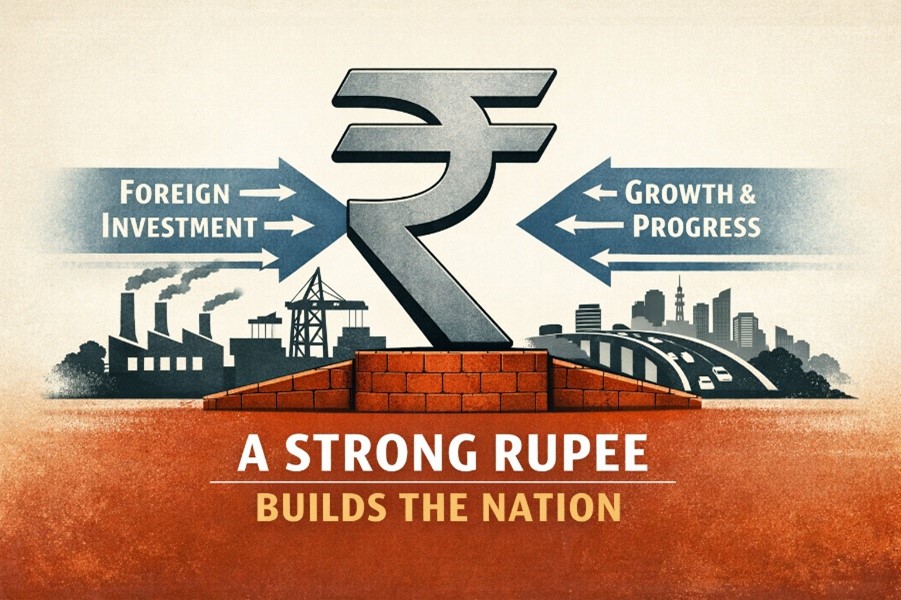

Why India must address currency uncertainty quickly to sustain its development momentum and attract the patient capital its next phase of growth demands.
By Ravishankar Kalyanasundaram
In March this year, global investors quietly withdrew billions of dollars from Indian financial markets. Within weeks, foreign portfolio investors pulled out more than $12–15 billion, reacting to rising oil prices, geopolitical tensions and a weakening sentiment across emerging markets. Yet the message behind those numbers deserves closer attention. Investors were not voting against India’s economic future. They were responding to uncertainty — particularly the fear that currency volatility could erode returns.
This distinction matters.
India today is not an economy searching for credibility. It is one of the few large nations where growth, demographics, entrepreneurship and domestic demand are moving forward together. Highways are stretching across the country, manufacturing clusters are expanding, logistics networks are modernising, and digital infrastructure is reshaping commerce and services. The scale of India’s ambition is immense. Infrastructure investment alone is expected to require more than ₹140 lakh crore by the end of this decade, while bank credit demand continues to rise by nearly ₹20 lakh crore every year as businesses expand and cities grow.
This is the tempo of a nation building its future.
Behind every highway, factory, port, logistics corridor and digital network now rising across India lies one silent requirement — a continuous flow of long-term capital.
But development at this pace requires more than optimism. It requires capital that is patient, confident and willing to remain invested through cycles of global uncertainty.
And capital flows toward certainty.
For many international investors, the hesitation is not India’s economy. It is the rupee. A project yielding twelve percent in rupee terms can lose much of its attraction if the currency depreciates by five or six percent annually. Even when businesses perform well, exchange-rate volatility can quietly erode returns. In that sense, currency instability becomes an invisible tax on long-term investment.
India has faced such moments before — and has responded with imagination.
During earlier episodes of foreign exchange stress, policymakers designed innovative instruments to mobilise global confidence. Diaspora bonds during the early 1990s crisis, Resurgent India Bonds in 1998, and India Millennium Deposits in 2000 collectively attracted billions of dollars from Indians living abroad. In 2013, when the rupee again came under severe pressure, a special foreign-currency deposit window introduced by the Reserve Bank of India enabled banks to mobilise more than $30 billion within months, helping stabilise the currency and restore confidence.
These were not merely financial schemes. They were signals that India’s institutions understood the urgency of the moment and were willing to innovate.
The opportunity today may be even larger.
India already receives more than $135 billion every year in remittances, the largest inflow anywhere in the world. Even a modest redirection of a small fraction of these flows into structured long-term instruments could generate tens of billions of dollars in additional capital for the domestic economy. Such inflows would strengthen the balance of payments, support the rupee and provide resources for infrastructure and industrial growth.
There is also clear evidence of what patient capital can achieve in India. Sovereign investment institutions such as Temasek Holdings and GIC have deployed billions of dollars across Indian banks, technology companies, logistics networks and consumer enterprises over the past two decades. Many of these investments have generated substantial long-term gains, demonstrating the remarkable capacity of India’s economy to compound value when capital is allowed to remain invested for long horizons.
The question therefore is not whether capital exists. It is whether institutions can reduce the uncertainty that prevents that capital from committing itself to India for longer periods.
Policymakers in the Ministry of Finance and the RBI have rightly emphasised that India operates a managed-floating exchange-rate system and that the country’s external fundamentals remain strong. But the moment may have arrived to consider whether a new institutional mechanism can further strengthen investor confidence.
Such a framework could offer limited protection against excessive currency volatility for long-term capital flows. It need not be an open-ended guarantee. Carefully designed instruments — such as diaspora infrastructure bonds, swap facilities for banks mobilising long-tenor deposits, or structured hedging arrangements for strategic sectors — could reduce currency risk while ensuring that investors bear part of the cost through premiums or defined protection bands.
The objective would be simple: remove the fear that exchange-rate movements will wipe out otherwise sound investments.
If India could attract even $20–30 billion a year of steady long-term capital through such mechanisms, the benefits would be significant. The rupee would gain stability. Banks would access longer-tenor resources for lending. Infrastructure projects would secure patient capital. Financial markets would deepen as investors commit themselves to longer horizons rather than short-term cycles.
India does not lack capital because the world doubts its potential. It lacks capital when uncertainty clouds the rules of the game. When institutions remove that uncertainty — whether in regulation, taxation or currency stability — investment follows with remarkable speed.
The real danger today is not that capital will disappear forever. It is that hesitation may slowly creep into the sentiment surrounding India’s extraordinary development momentum. At moments like this, policy imagination becomes as important as macroeconomic management.
India’s growth story has reached a stage where maintaining confidence is as important as creating opportunity. The rupee therefore cannot be viewed merely as an exchange rate to be defended in the market each day. It is the financial foundation upon which the next phase of India’s economic expansion will stand.
The moment may therefore call for fresh institutional imagination from the Reserve Bank of India and the Ministry of Finance — institutions that have repeatedly demonstrated their ability to respond creatively in moments of economic challenge. If such imagination emerges again, the rupee will not merely stabilise. It will become the quiet assurance that the world’s capital can participate confidently in building India’s future.




 Business and Economy
  Education
  Food
Food  Government
  Lifestyle
  Politics
  Travel
  World
World