
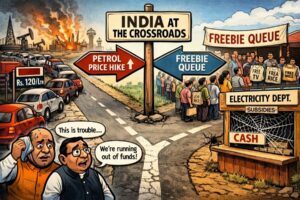
When elections become auctions, development becomes the casualty.
By Ravishankar Kalyanasundaram
How much of Tamil Nadu’s future is being quietly spent today in the name of electoral generosity?
Tamil Nadu today spends ₹52,603 crore a year on subsidies, up sharply from ₹37,749 crore just a year earlier — an increase of nearly 39 percent in a single year. With the state’s total expenditure projected at about ₹4.39 lakh crore, this means that one out of every eight rupees spent by the government already goes into subsidies and giveaways rather than into building assets for the future.
Now place the new election promises beside this arithmetic.
Tamil Nadu has roughly 2.28 crore ration-card holding families. A promise of ₹2,000 per month to each family alone would cost the treasury about ₹55,000 crore every year. Add the cost of free LPG cylinders, scooter subsidies, expanded transport concessions, and other benefits promised in manifestos, and the recurring burden could easily reach ₹65,000–70,000 crore annually.
If implemented, Tamil Nadu’s subsidy bill could therefore rise to around ₹1.17 lakh crore every year.
That represents a dramatic shift in the state’s finances. Subsidies would rise from about 12 percent of government spending today to nearly 26–27 percent of the entire budget. In simple terms, Tamil Nadu would move from spending one rupee in eight on subsidies to almost one rupee in four.
This is not merely a political decision. It is a developmental crossroads.
To understand the gravity of such spending, one must imagine the opportunity cost. ₹65,000 crore a year is not just another line in the budget. It is the scale of investment that can transform a state.
A modern government medical college with a 1,000-bed teaching hospital costs roughly ₹600–700 crore to build and equip. The same money could therefore establish around 90 to 100 new medical colleges and hospitals across Tamil Nadu — enough to revolutionise healthcare access in every district.
Metro rail systems, which reshape urban mobility and reduce congestion, cost roughly ₹300 crore per kilometre. The same resources could construct over 200 kilometres of metro rail, expanding modern transit networks across cities such as Coimbatore, Madurai, Tiruchirappalli and Salem.
Electricity, the backbone of industry, tells a similar story. A 1,000 MW power station typically costs about ₹6,000–7,000 crore. The annual cost of these giveaways could therefore build eight to ten major power stations, securing the energy needs of the state’s growing manufacturing economy.
Infrastructure could expand dramatically as well. At an approximate cost of ₹10 crore per kilometre for modern highways, ₹65,000 crore could build over 6,000 kilometres of high-quality roads, connecting industrial clusters, logistics parks and ports across the state.
Tamil Nadu’s maritime strength could also be strengthened. With ₹5,000–6,000 crore, the state could develop a modern port terminal. The same resources now proposed for recurring giveaways could create ten new port terminals, reinforcing the state’s position as one of India’s leading export gateways.
These are precisely the investments that once made Tamil Nadu one of India’s most progressive and industrialised states.
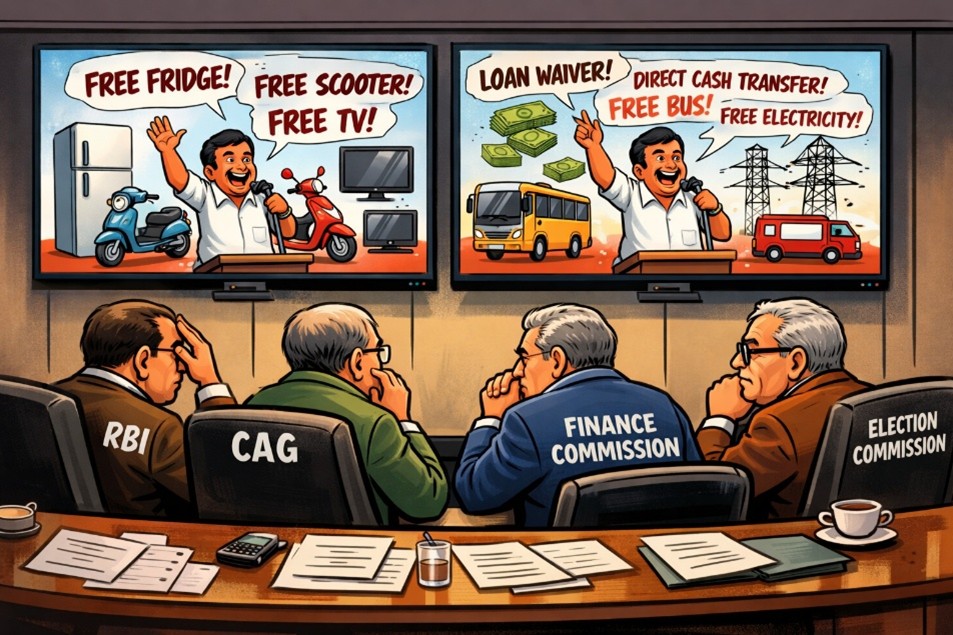
Instead, the money risks disappearing every year into consumption transfers — refrigerators, scooters, cash payments and loan waivers that leave no enduring economic asset behind.
The danger therefore is not merely fiscal arithmetic. It is the quiet erosion of a state’s future.
When governments begin spending one quarter of their budgets on electoral giveaways, something fundamental begins to change. Hospitals that could have healed the poor are never built. Power stations that could have powered industry remain drawings on paper. Metro lines that could have transformed cities are postponed indefinitely. Roads, ports and universities that could have created the next generation of prosperity simply never appear.
The tragedy is deeper still. The very citizens who receive these short-term benefits are often the ones who lose the most. A free appliance may ease a household for a moment. But a missing hospital, a delayed industrial project or an absent transport network silently denies millions the opportunities that sustained development brings.
Welfare has a rightful place in a humane society. A government must protect the vulnerable and support those who struggle. But when welfare degenerates into a competitive auction of promises, the moral purpose of governance begins to fade.
The treasury stops financing progress. It begins financing applause.
And slowly, almost unnoticed, a state that once invested in building its future starts spending that future away — one election at a time.

 Business and Economy
  Education
  Food
Food  Government
  Lifestyle
  Politics
  Travel
  World
World