
What the IndiGo episode reveals about regulatory delay, consumer risk, and why India must stop supervising success only after it stumbles
By Ravishankar Kalyanasundaram
The IndiGo episode should not be read as an isolated corporate problem. It is a governance signal. It tells us how thin our guardrails have become once private capital enters a sector at scale. It tells us that the state still believes markets self-correct — despite decades of evidence that they self-concentrate.
Most worryingly, it tells us that India is comfortable building national dependence on single entities without building institutional oversight to match that dependence.
This is not a call to clip private enterprise. It is a call to grow up as a regulatory state.
IndiGo today carries more than half of India’s domestic flyers. For millions, flying is no longer a luxury but a necessity — for work, emergencies, and family obligations. When a single airline becomes the backbone of national mobility, its failures stop being corporate inconveniences. They become consumer risks.
That is precisely where regulation is meant to step in — not after chaos, but before fragility hardens into dependence.
Yet for a long period, things appeared to be working. IndiGo expanded capacity when others failed. It kept fares low in a price-sensitive market. It brought predictability to a sector long plagued by collapse. In doing so, it became not just successful, but stabilising.
That success earned trust. And trust slowly turned into tolerance.
Oversight remained largely procedural — compliance was checked, but resilience was not stress-tested. Market dominance was observed, but not treated as a trigger for higher obligation. As long as safety indicators stayed within limits and disruptions remained manageable, the state appeared content to watch from the sidelines.
Then the stance changed.
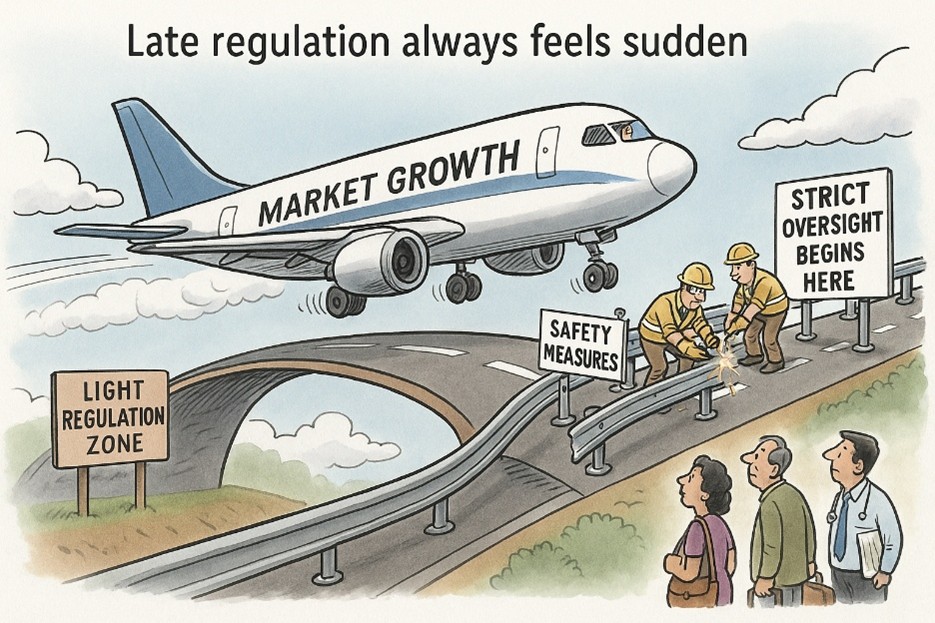
Safety measures were insisted upon more firmly. Oversight tightened. Corrective interventions arrived. And resistance followed.
Here lies the uncomfortable truth.
Resistance was not an act of defiance against safety. It was a reaction to sudden constraint after prolonged freedom.
Late regulation often looks like overregulation to those who grew in its absence.
Had safety buffers, redundancy requirements, crew sustainability norms, and operational stress tests been insisted upon earlier — when market share was steadily climbing — they would have been absorbed gradually. Instead, intervention arrived when the airline had already become systemically critical. Any restriction at that stage was bound to feel disruptive, even punitive.
So yes, the government did act. But it acted after allowing a situation to mature where acting would inevitably cause turbulence.
This explains the confusion in public discourse. One side says regulation was enforced. The other says it was abrupt. Both are partly right — because the framework that should have aligned growth with supervision was never built.
Yet this does not absolve IndiGo.
Dominance brings obligation. When an airline carries a majority of a nation’s passengers, it ceases to be just another market participant. It becomes part of national infrastructure — whether it likes that label or not. With that status comes responsibility: for redundancy, workforce sustainability, grievance redressal, and consumer protection that go beyond minimum compliance.
The deeper governance failure lies in allowing this ambiguity to persist for so long.
Regulation was treated as episodic — stepped up only when stress became visible. Oversight should instead have been progressive, increasing automatically as scale and dependence grew. That did not happen.
Aviation is not alone in revealing this flaw.
Public health offers a sobering parallel. India’s private healthcare system has expanded rapidly, but regulation still arrives most forcefully after mishaps — a tragic death, an inflated bill, a public outcry. Pricing transparency, clinical accountability, and grievance redressal remain uneven. Patients enjoy choice until something goes wrong. Then the state intervenes, briefly and belatedly, before retreating again.
Telecom tells a similar story. Years of unrestrained competition were celebrated until balance sheets collapsed and concentration hardened. Market forces did not self-correct; they cannibalised. When collapse loomed, the government stepped in — not as a regulator enforcing discipline, but as a rescuer preserving continuity. Delayed regulation returned as systemic risk.
Across these sectors, the pattern is consistent. Liberalisation opens doors. Private scale accelerates. Dominance consolidates. Oversight grows cautious. Regulation arrives late — and feels disruptive when it does.
For consumers, this delay carries hidden costs. Fewer choices. Greater vulnerability. Uncertainty when systems falter.
If there is one lesson the IndiGo episode offers, it is this: do not wait until dependence hardens before regulation finds its voice.
India is entering a phase where private systems will increasingly become public arteries — moving people, healing bodies, carrying information. These are not playgrounds for regulatory experimentation. They are national infrastructure.
The choice is not between growth and regulation. It is between progressive oversight and episodic crisis management.
Good regulation does not interrupt success. It grows alongside it. It tightens gradually as scale grows, so that discipline never arrives as a shock. It protects consumers before dependence becomes exposure.
The IndiGo moment should therefore be read not as a story of villainy or victimhood, but as a warning — to the state as much as to enterprise.
Do not give long ropes without planning for the pull. Do not allow private success to substitute for public supervision. And above all, do not repeat this mistake in other sectors where regulatory measures are already overdue.
India’s next phase of growth will be judged not by how fast its companies expand, but by how wisely its institutions mature alongside them.
That lesson, at least, we can still choose to learn — before the next sector is grounded.


 Business and Economy
  Education
  Food
Food  Government
  Lifestyle
  Politics
  Travel
  World
World