
Russia doesn’t lack demand. India lacks the urgency to supply
By Ravishankar Kalyanasundaram
There are opportunities that come suddenly, and there are opportunities that sit in front of us for years, patiently waiting to be used. The India–Russia trade corridor is not a surprise, not a discovery, not breaking news. It is an open door we keep admiring instead of walking through.
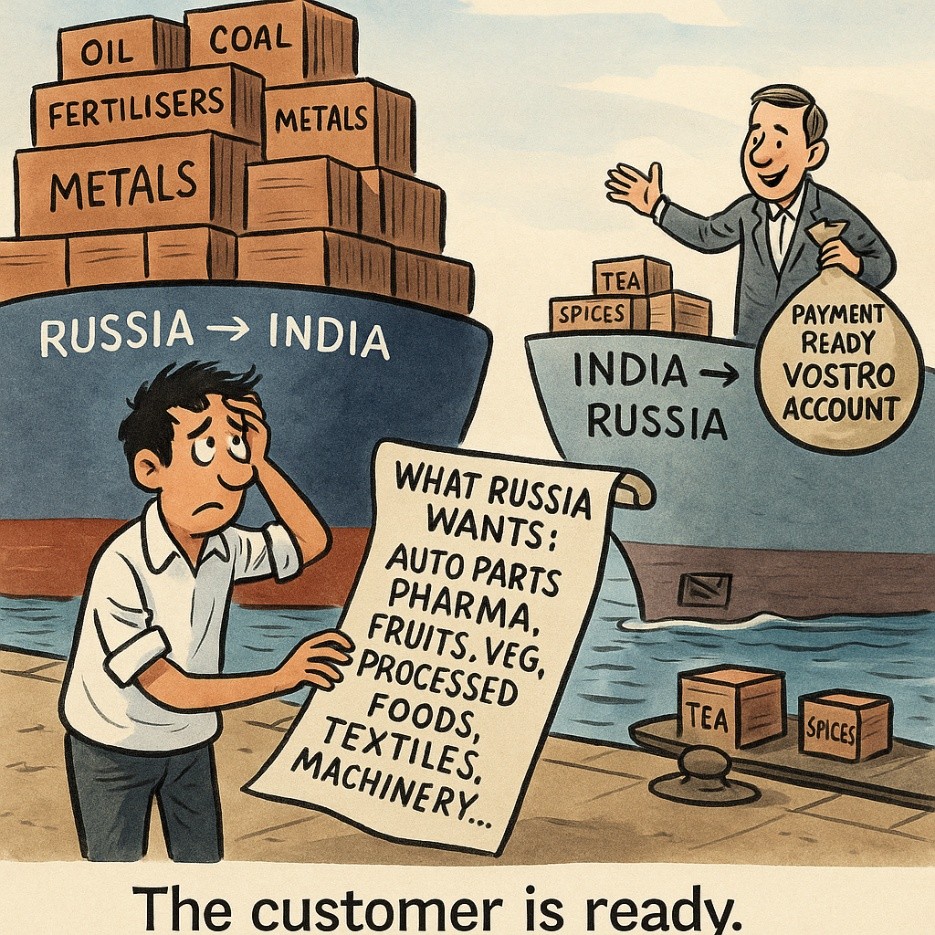
For years, India has depended on Russia for energy and raw materials. In FY 2024, bilateral trade touched nearly US$70 billion — but India exported barely US$5 billion and imported over US$60 billion. We buy oil, coal and fertilisers by the shipload, and in return we send only a small basket of engineering goods, pharma and tea. That is not a trade imbalance — it is a lost decade.
And it stings not because Russia is unwilling, but because Russia is actively looking to buy. It imports billions of dollars worth of auto parts, rubber goods, leather and footwear, home textiles, construction materials, medical equipment, processed foods, fresh fruits and vegetables, and pharmaceuticals. It is not a market waiting to develop — it is a market fully developed, waiting for us.
Small countries think big. We think “potential.”
Russia is the fourth-largest buyer of fresh fruits and vegetables in the world. Just two exporters — Turkey and Ecuador, countries smaller than some Indian states — ship over a billion dollars worth of bananas, apples, citrus and vegetables to Russia every year. South American countries like Chile and Peru turned fruit into their version of oil: Chile earns more from fruits than many oil economies earn from crude, and Peru built an agri-export engine that gives over US$12–15 billion a year, exporting grapes, avocados and blueberries to Russia, the US and EU.
Look at auto parts. Turkish and Chinese suppliers expanded aggressively into the Russian aftermarket. Neither country waited for long feasibility reports; they negotiated logistics, currency and warehousing, and captured billions.
Meanwhile, India — the world’s largest two-wheeler producer, the fourth-largest automotive manufacturing hub, and a global centre for rubber goods and engineering spares — has barely scratched Russia’s parts and accessories market.
The same applies to food processing. Russia imports pasta, noodles, confectionery, spices, canned vegetables, ready-to-eat meals and dairy products on a massive scale. India produces all of these. But we failed to create a Russia-facing export ecosystem — port corridors, cold chains, packaging standards, last-mile distribution and ruble/rupee settlement support.
The financial channel was ready — we didn’t use it
For the first time in decades, India didn’t have to worry about dollar clearance to export to Russia. After sanctions disrupted payments, Moscow opened special rupee vostro accounts in Indian banks. The whole mechanism was built specifically to help exporters:
✔ Invoice in rupees
✔ Receive payment instantly
✔ No forex risk or delay
✔ Funds already parked and waiting
What happened?
Indian importers paid billions for oil. Roubles converted to rupees accumulated in vostro accounts. And exporters… mostly stayed home. Goods didn’t sail. Containers didn’t move. The financial channel waited for the physical channel — and the physical channel never came. It may be the single biggest snapshot of our hesitation: even when the money was waiting, we didn’t show up with the goods.
Services exports — another missed wave
Russia isn’t only hungry for products. It is undergoing an accelerated transition in:
Who leads globally in IT services, SaaS customisation, cybersecurity talent and animation? India.
Who is replacing Western technology vendors in Russia? China, Turkey and UAE, not India.
Russian companies have openly sought Indian cloud support, cybersecurity outsourcing, payment systems integration and software customisation. India’s biggest IT firms have the capability — but they haven’t mobilised because Russia hasn’t been seen as a “strategic market” the way the US and Europe are. Yet Russia is now a forced technology importer, and we are sitting on a services opportunity worth billions.
Even in tourism and healthcare, Middle Eastern countries are aggressively marketing medical tourism to Russia. India has better hospitals, lower cost and higher global patient satisfaction — yet there is no coordinated initiative for Russian patients, insurance tie-ups, or direct booking facilitation.
Our problem is not talent or product — it is organisation
Every time this conversation comes up, someone says, “But Indian exporters are interested. Russian buyers are interested. So what’s missing?”
Three simple words: infrastructure for outcomes.
It is one thing to produce mango pulp or auto components. It is another thing to:
Other nations do this through state-industry alliances. We keep doing it through seminars and photo-ops.
The world is re-allocating supply chains — we are waiting for a reminder
The Ukraine war and sanctions forced Russia to re-map its entire import-supply ecosystem. Europe retreated. Russia actively looked for new partners. China, Turkey, UAE, Brazil, Armenia and Central Asian suppliers mobilised instantly.
India — which enjoys goodwill and political capital like few others — watched the window open… and continued watching.
This is what hurts: The door to Russia didn’t open because we are special. It opened by default — because others stepped back. We still didn’t step forward.
It is time to graduate from excitement to execution
We have the products. We have the services. We have the relationship. We even have the payment mechanism.
What remains is the part India often avoids — operational discipline.
If we are serious about correcting this decade-long imbalance, three steps can change the India–Russia export story within 36 months:
Russia isn’t a “maybe someday” market.
It is the biggest open opportunity India ever ignored.
Containers full of oil arrive in India every day.
Containers full of opportunity return to Russia empty.
Unless we change that, the rupee–rouble settlement will remain the biggest metaphor of Indian trade strategy: we designed a mechanism where Russian money waited for our exports — and we still didn’t show up.
Now the question isn’t whether Russia is ready.
The question is whether we are.


 Business and Economy
  Education
  Food
Food  Government
  Lifestyle
  Politics
  Travel
  World
World