
As world leaders bow to Trump’s theatre of power, India must ask: is clarity our strength—or our undoing?
By Ravishankar Kalyanasundaram
There’s a new procession of courtiers in the world’s capitals. From Tokyo to Brussels, from Riyadh to Singapore, leaders are lining up—some eager, others cautious—to flatter Donald Trump as he re-enters the global stage. His rallies may look like entertainment, but his policies are rarely jokes. Trade, tariffs, and diplomacy—each turn on how loudly a country applauds.
Not long ago, we smiled when Pakistan’s then prime minister nominated Trump for the Nobel Peace Prize. It felt like a circus act. But when Japan’s Prime Minister followed with her own words of praise, the laughter stopped. What began as parody became practice. Today, ASEAN leaders host him with fireworks, Gulf monarchs promise energy deals, and Europe finds polite new synonyms for the word “appeasement.” Even China’s premier, in his recent meeting, walked the line between pride and pragmatism—smiling for the cameras, offering trade niceties, and making sure not to provoke the tariff hammer.
The choreography is unmistakable: the world has chosen flattery over friction.
India’s Straight Talk, and the Cost of It
Amid this global caution, India took a different road. In earlier rounds, New Delhi chose to stand tall, insisting on clarity and parity—an approach that earned applause at home but irritation in Washington. When we declared that it was we who had “called the truce” after the Pulwama tensions, Trump heard
it as a rebuff. For a man who measures diplomacy in deference, that sounded like defiance.
Could we have played it differently? Perhaps.
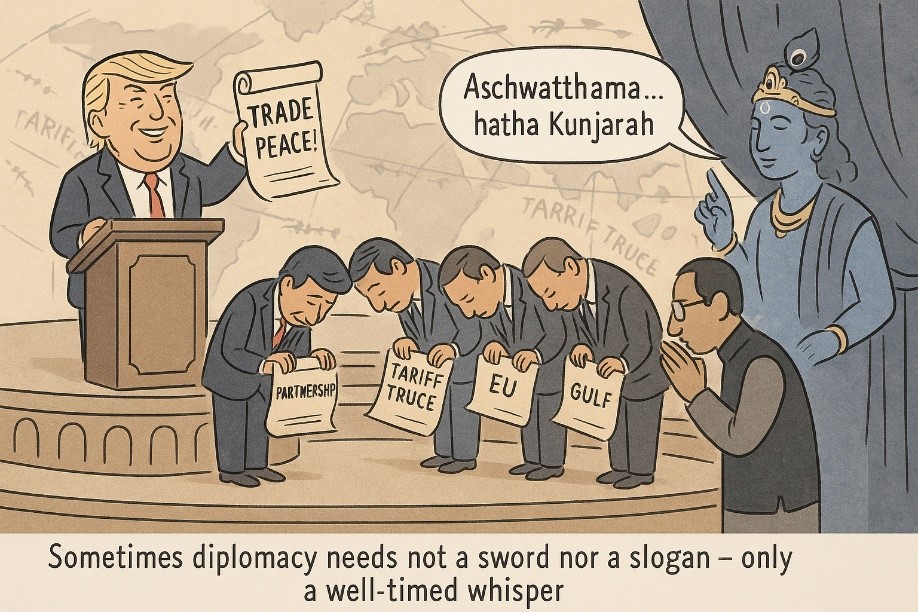
In Mahabharata, Krishna taught Yudhishthira to win through words—not by deceit, but by design. “Ashwatthama hatha Kunjaraha.” “Ashwatthama is dead… the elephant.” The half-truth that changed a war. What if we had used a similar craft—neither denial nor declaration, just enough ambiguity to let each side claim comfort?
Trump could have returned home a peacemaker, and we could have kept our exporters free from the tariff storm that soon followed.
When Pride Meets Policy
We like to think of straight talk as strength. But diplomacy, like chess, rewards patience more than pride. In this age of transactional politics, clarity often invites cost.
The tariffs that followed dented more than trade—they dented trust. Our exporters felt the sting of unpredictability, and foreign investors quietly recalculated risk. The world’s largest democracy had spoken plainly, but the world’s loudest democracy had not liked what it heard.
Add to this the ripple of sanctions that forced Russian oil out of our shopping list, and suddenly the “strategic autonomy” we prided ourselves on looks narrower. We paid more for oil, juggled tighter trade margins, and found ourselves explaining our neutrality to both camps—without pleasing either.
Was this the price of principle, or the cost of poor timing?
The Theatre of Power
Elsewhere, the world adjusted quickly. The Japanese gave flattery a cultural finesse, ASEAN leaders called it “partnership,” and the Gulf called it “alignment.” Even China—once the villain of Trump’s trade tirades—learned to package calm with courtesy. When Trump fumes, they flatter; when he smiles, they sign.
In that contrast lies an uncomfortable question: are we any wiser than those we mock? We see others bending, but are we walking straighter—or simply standing alone?
Diplomacy is not an honesty contest. It’s a craft of calibrated expression. The Americans practise it with spin, the Chinese with patience, the Japanese with politeness. We, meanwhile, sometimes mistake rhetoric for resolve.
Borders, Markets, and the Missing Pause
It isn’t only tariffs. Our northern and western borders today echo with unease—Pakistan restless, Bangladesh wary, China watchful. None of these are Trump’s making alone, but a less strident tone with Washington might have softened the noise. Had we kept ambiguity alive—had we allowed Trump to imagine he was the peace-broker between India and Pakistan—perhaps he would have stayed distracted by the glory, rather than angered by the headlines.
Instead, we offered clarity, and clarity comes with consequences.
Would ambiguity have kept Pakistan at bay and calmed our borders? Would the tariffs have been gentler on our exporters? We cannot know. But we do know that in global diplomacy, the line between principle and pragmatism is often drawn in disappearing ink.
The Silent Wisdom We Forgot
India’s strength has never been in the volume of its declarations but in the calm of its restraint. Narasimha Rao liberalised an economy with fewer press conferences than cabinet meetings. Vajpayee made peace with a poem, not a policy paper. Even Manmohan Singh, whose words were few, steered crises with composure.
Somewhere in our search for global stature, we began to confuse visibility with influence. Yet, as Krishna once reminded Arjuna, “even silence can be speech when the purpose is clear.”
In a world that thrives on provocation, restraint itself can be power.
The Thought That Lingers
Trump’s current world tour will pass. Leaders will go back to governing their restless economies. But India must pause to reflect—not on the applause, but on the outcome.
Our exporters count the costs. Our diplomats juggle explanations. Our neighbours measure intent.
And so the question returns: Is India’s strategy winning?
If victory is applause at home, perhaps yes. But if victory is smoother trade, quieter borders, and global confidence, then maybe not yet.
The Mahabharata offers a reminder that survives every age. Sometimes, the war is not won by might, or even by truth—but by wisdom in how the truth is told.
Because on the world’s battlefield of tariffs, sanctions, and pride, clarity can wound faster than conflict.
And the difference between triumph and turmoil may still rest in the whisper that once changed a war:
“Ashwatthama… hatha Kunjaraha.”
 Business and Economy
  Education
  Food
Food  Government
  Lifestyle
  Politics
  Travel
  World
World