
In a world of fractured geopolitics, volatile trade and fragile supply chains, fiscal discipline and decisive action — not announcements — will determine India’s stability.
By Ravishankar Kalyanasundaram
The Finance Minister’s announcement of a stabilisation fund is an acknowledgement of gathering global economic turbulence. The fund is intended to provide a financial buffer against sudden spikes in crude prices, exchange-rate pressures and disruptions in exports or capital flows. In principle, such a mechanism can help the government intervene quickly — moderating domestic fuel prices, supporting stressed sectors and maintaining macroeconomic confidence when global markets turn hostile.
But the scale of the challenge confronting India demands a deeper and more urgent response.
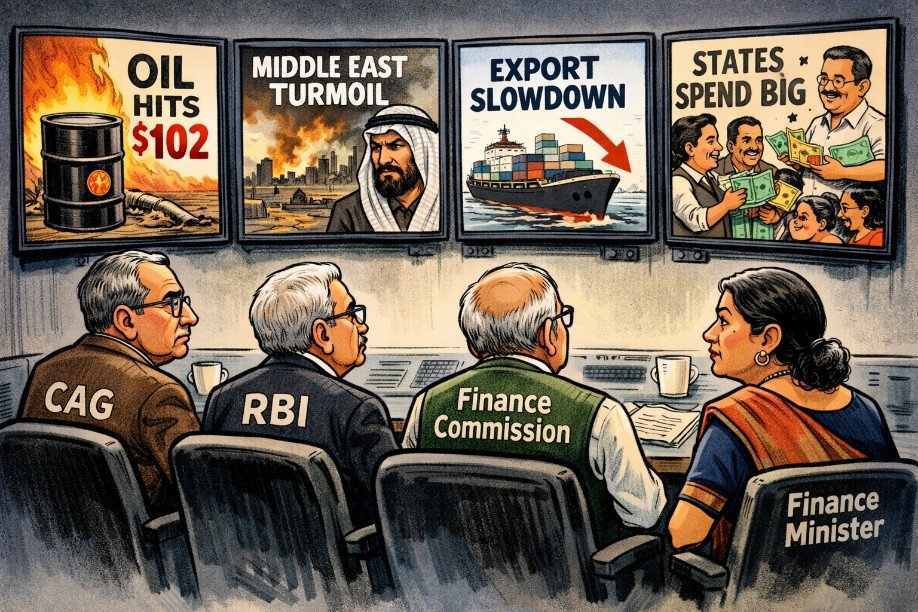
The global environment has entered what may well be a prolonged phase of instability. Crude oil prices have now surged back into triple-digit territory, trading around $100–$103 per barrel in recent days amid escalating geopolitical tensions and fears of supply disruption. For India, which still imports nearly 85 percent of its crude requirement, this is not just a commodity movement — it is a macroeconomic stress signal. Each sustained increase in oil prices expands the import bill, adds to inflationary pressures and complicates fiscal management.
External vulnerabilities are also becoming more visible. India continues to receive over $120 billion annually in remittances, much of it from workers in the Gulf and West Asia. Rising geopolitical uncertainty and slowing project activity in parts of the Middle East are already creating concerns about job continuity for expatriate workers. Any prolonged disruption in employment prospects there can affect household consumption patterns across India and weaken a critical source of foreign-exchange inflow.
Exports, meanwhile, are facing a more uncertain outlook. Persistent supply-chain disruptions, shipping delays and dampened demand sentiment in key global markets are beginning to weigh on order pipelines. India’s merchandise exports, which had approached $450 billion, now face the risk of flattening growth or even short-term contraction if global trade conditions deteriorate further. Industrial sectors dependent on external demand are therefore entering a period of caution in hiring and investment.
Currency dynamics add another layer of complexity. While India’s foreign-exchange reserves remain significant, global capital flow volatility and widening trade imbalances can quickly test confidence in the rupee. At the same time, the country’s combined public debt — including central and state governments — continues to remain above 80 percent of GDP, limiting fiscal flexibility in responding to large external shocks.
In such a scenario, stabilising domestic fuel prices, protecting export competitiveness and sustaining macroeconomic credibility will require far more than a contingency fund. These objectives demand sustained fiscal space — and fiscal space can only be created through disciplined public finance and prioritised spending.
Yet across the country, competitive welfare expansion and politically driven concessions continue to stretch government finances. Subsidies, cash transfers and short-term relief measures often grow faster than revenue mobilisation. While social protection remains necessary, the absence of careful prioritisation risks crowding out investments in infrastructure, energy security, technology capacity and defence preparedness — investments that determine resilience in a volatile global order.
The responsibility therefore lies not just in acknowledging risks but in acting decisively to mitigate them. Strategic petroleum reserves must be strengthened. Export diversification must move from policy intent to measurable outcomes. Fiscal coordination between the Union and the states must become more transparent and accountable. Above all, economic governance must shift from episodic announcements to sustained execution.
India’s economic rise has always been shaped by its ability to adapt to global shifts. But the present moment suggests that uncertainty itself is becoming the new normal. Citizens and investors are no longer reassured by statements alone. They look for evidence that the nation’s finances are being prepared for shocks that are already visible on the horizon.
The stabilisation fund signals awareness. What India now requires is resolve.
Because economic storms rarely announce their full force in advance.
They gather quietly — in rising oil prices, anxious export markets and uncertain jobs abroad.
And by the time their impact is fully felt, preparation is no longer a choice.
It is either already done — or already too late.



 Business and Economy
  Education
  Food
Food  Government
  Lifestyle
  Politics
  Travel
  World
World