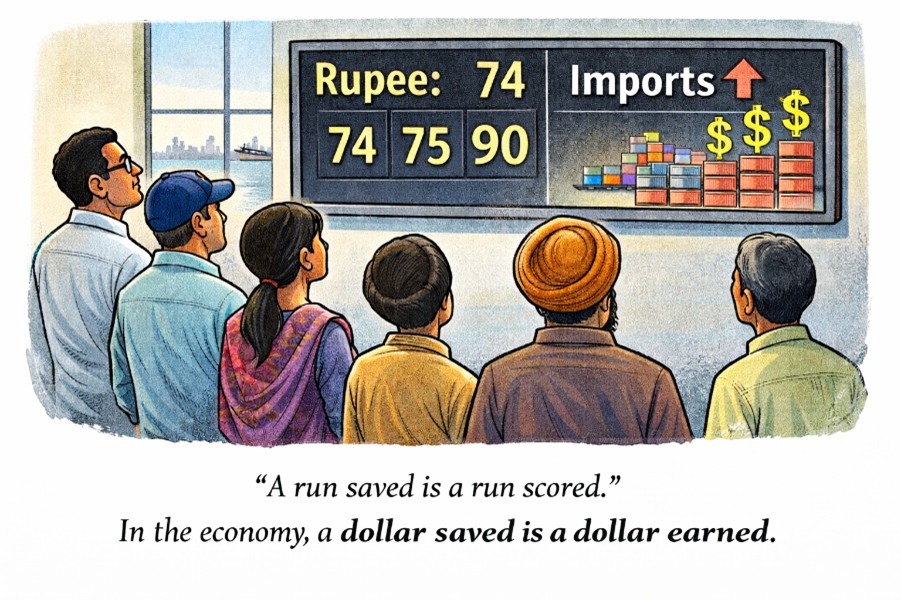

2025 exposed how easily dollars slip away. 2026 must be the year India learns to save what it earns.
By Ravishankar Kalyanasundaram
Before the rupee weakens on television screens and market tickers, it weakens quietly elsewhere.
It weakens when more dollars leave the country than come in. When oil import bills rise. When edible oils, electronics, minerals, and metals are paid for in dollars year after year. When exports slow, or when foreign investors pull money out faster than trade and services can replace it. By the time the rupee’s slide becomes visible, the pressure has already been building for months.
That is exactly what India experienced in 2025.
Sanctions complicated rupee settlement of Russian oil. Tariff actions hit Indian exports to the United States. Foreign institutional investors withdrew billions of dollars in phases. And the Reserve Bank of India was forced to step in repeatedly, selling dollars from its reserves—not to grow the economy, but to prevent disorder. The rupee did not weaken because of panic or mismanagement. It weakened because dollars were leaking out faster than they were being replenished.
India entered 2025 with foreign exchange reserves of around $640 billion, a position of strength by any global standard. Yet a meaningful portion of that buffer had to be deployed defensively. The system held, but the lesson was clear: earning dollars matters—but stopping avoidable dollar leakages matters just as much.
This is where an old cricketing truth suddenly feels relevant.
Sunil Gavaskar often said it while commentating: “A run saved is a run scored.” Matches, he reminded us, are not won only by big shots, but by discipline—by refusing to give away what need not be conceded.
Economies work much the same way.
India today imports goods worth over $700 billion every year. Energy alone—crude oil, gas, and coal—accounts for nearly $170 billion of that bill. A simple fact explains why the rupee remains under pressure: every $10 increase in crude prices adds roughly $15 billion to India’s import cost. That money must be found—from exports, reserves, or borrowing.
But energy is only the most visible dollar drain.
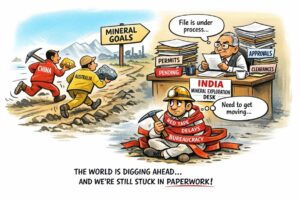
Mining reveals the deeper structural problem. India has explored barely 8 percent of its mineral-rich land, compared to over half in countries like Australia and Canada. The result is predictable. Despite geological potential, India imports almost all its lithium, a large share of its copper, and nearly all rare-earth processing.
Copper tells the story clearly. A decade ago, India was close to self-sufficiency. When domestic smelting capacity declined, India became a net importer almost overnight. Between 2018 and 2024, copper imports ran into several billion dollars. When global prices surged past $10,000 per tonne, Indian industry paid—in dollars—for a metal we once produced at home. This was not inevitable. It was the cost of delay.
Large industrial projects suffered the same fate. POSCO’s proposed $12 billion steel project in Odisha never took off after years of delay. Rio Tinto exited after discoveries were made but approvals dragged on. In mining, time lost is value lost. Miss a commodity cycle, and what could have reduced imports ends up increasing them.
Now India stands at another test: lithium in Jammu and Kashmir. Global lithium demand is expected to grow nearly sixfold by 2030. India already imports lithium and batteries worth over $7 billion annually, and the figure is rising. Every year of delay risks another billion dollars flowing out.
Agriculture shows that dollar leakage is not limited to industry. India imports edible oils worth $12–13 billion every year. Despite repeated national missions, production has not kept pace with consumption. Every spike in global prices hits Indian kitchens and drains dollars abroad. Few imports affect daily life and the balance of payments so directly.
Electronics present another quiet leak. India exports smartphones but imports key components worth over $60 billion annually. Even modest domestic value addition could save $8–10 billion a year.
Defence imports of $8–10 billion annually, and even small improvements in energy efficiency—where a 1 percent gain can save $4–5 billion—tell the same story.
India does not lack opportunity. India loses time. And time lost becomes dollars lost.
This is why saving dollars cannot be New Delhi’s job alone. Minerals, power, land, logistics, and clearances sit with states. A Dollar Saving Mission must be national in spirit—Centre and states working together, treating delay itself as an economic cost.
The RBI can defend the rupee. But the cheapest defence is prevention. A dollar saved by building capacity at home is far cheaper than a dollar sold from reserves in a crisis.
Sunil Gavaskar never said runs should not be scored. He simply reminded us that matches are often won by discipline in the field.
As India looks towards 2026, the question is not whether we can earn dollars—we can. The real question is whether we can stop letting them slip away.
Because in today’s world, a dollar saved may be India’s most valuable run.



 Business and Economy
  Education
  Food
Food  Government
  Lifestyle
  Politics
  Travel
  World
World