
History shows that global disorder rarely begins with war, but with the quiet normalisation of coercion
In the 1930s, this is how trouble began.
Diplomacy became coercive. Treaties were dismissed as restraints on national strength. Economic pressure—sanctions, trade barriers, currency moves—was seen as a legitimate way to force political outcomes. Multilateral institutions were mocked as weak, slow, and outdated.
The result was not immediate war. It was something more dangerous: strategic drift. Countries began to hedge. Allies lost confidence. Rearmament returned quietly, justified as prudence rather than aggression. Each nation started acting alone because shared rules no longer felt dependable.
We see echoes of that logic today.
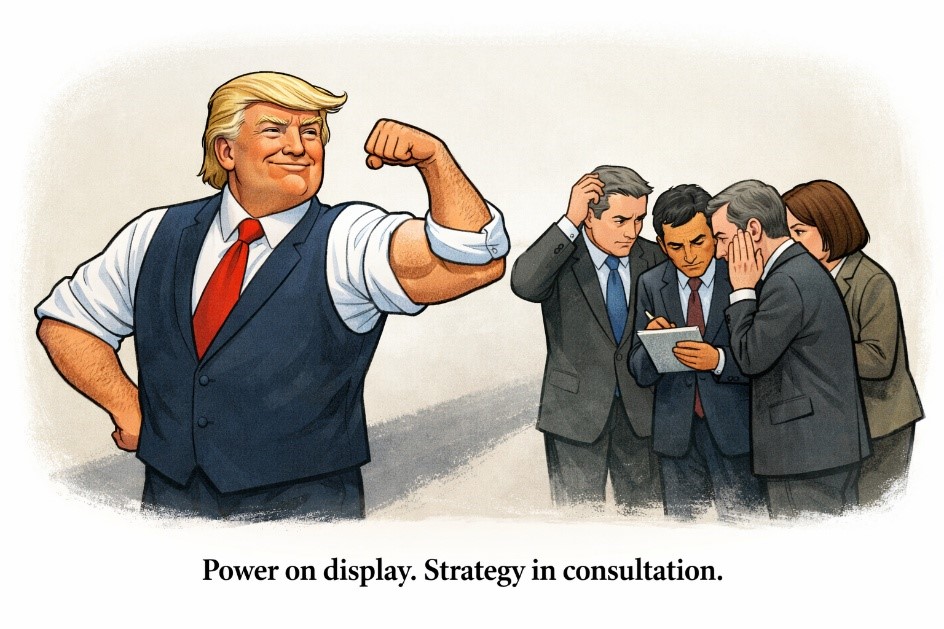
Recent tensions over tariffs, strategic geography like Greenland, and the way alliances are being treated have unsettled Europe and beyond. What worries many diplomats is not any single decision, but the mindset behind them: the belief that power works best when it is direct, transactional, and unencumbered by institutions.
This is the return of raw power politics—less patient, less trusting of rules, and skeptical of institutions built for consensus rather than speed.
History does not repeat itself in neat cycles, and it is important to be precise. This is not the rise of fascism. There is no mass militarisation of society, no totalitarian mobilisation, no ideological push for conquest. The United States is not a defeated power seeking revenge; it is a dominant one anxious about relative decline.
Europe today, through the European Union, is also far more economically integrated than it was in the 1930s. Supply chains, capital markets, and shared institutions create buffers that did not exist then.
But while the context is different, the instinct is familiar.
When tariffs are used not just as economic tools but as political weapons, when territory is spoken of as an asset rather than a responsibility, and when institutions like NATO are treated as leverage rather than anchors, the same unravelling logic begins to appear.
The real danger is not one leader or one country.
It is contagion.
When a major power signals that rules are optional, others adapt quickly. Borders become “discussable.” Trade becomes punishment. Security shifts from collective assurance to private insurance. Countries start planning not for cooperation, but for uncertainty.
Disorder rarely begins with invasion.
It begins with distrust.
For countries like India, this moment matters deeply. India has long relied on rules, restraint, and strategic autonomy to protect its interests in a world of unequal power. A global order based on deals rather than norms favours the loud, the large, and the impatient—not those who depend on balance and predictability.
The lesson of the 1930s is often reduced to a warning about dictators. That misses the point.
The real lesson is this: when institutions are weakened and coercion becomes normal, even democracies can stumble into conflicts they never planned. Not out of ambition, but out of miscalculation.
There is reason to be concerned today—not because history is repeating itself, but because we are forgetting why the post-war order was built in the first place. It was created not just to restrain ambition, but to manage fear, mistrust, and misjudgement among powerful nations.
When that memory fades, the world does not collapse suddenly.
It drifts—quietly, confidently—toward trouble.

 Business and Economy
  Education
  Food
Food  Government
  Lifestyle
  Politics
  Travel
  World
World