
In a world where restraint is mistaken for weakness, can peace still survive?
By Ravishankar Kalyanasundaram
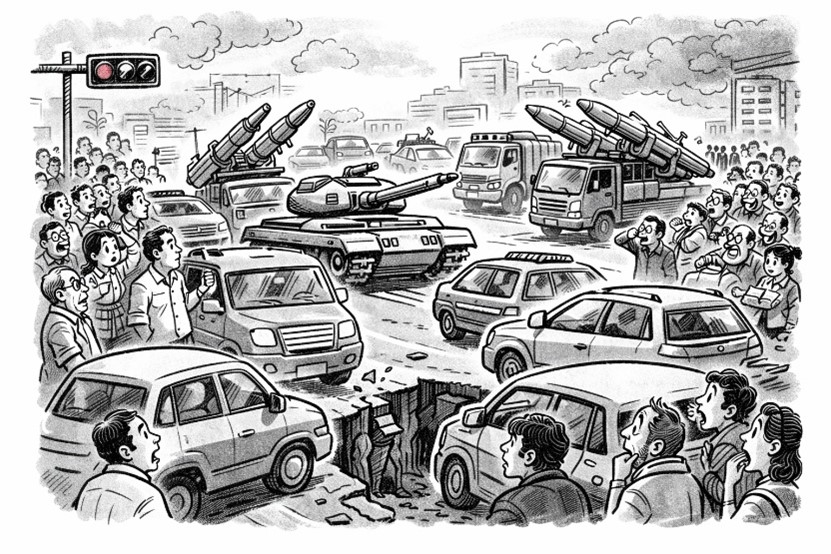
When the United States moved militarily into Venezuela under the language of “restoring order” and “protecting interests,” the act itself was alarming. But what was more disturbing was not the intervention—it was the reaction to it. Or rather, the absence of one.
There were no emergency summits with authority. No sustained diplomatic resistance. No institutions asserting restraint. There were statements, expressions of concern, a brief pause in the news cycle—and then silence.
That silence matters more than the intervention itself.
It signals that intervention is no longer extraordinary. It is conditional. It depends not on rules, but on power balances; not on law, but on strategic convenience; not on principle, but on whether the moment unsettles markets or alliances. It tells smaller nations that their sovereignty is negotiable. It tells peaceful nations that restraint may be mistaken for weakness.
What changed in 2025 is not the act of intervention—history is full of those—but the reaction to it. There is no longer even a pretence of collective restraint. The language of international order remains, but belief in it has thinned.
If institutions cannot protect you, and neutrality no longer shields you, what remains? Military strength? Economic coercion? Strategic alignment? Silence?
History has confronted the world with this question before.
In the late nineteenth century, colonisation did not begin with armies alone. It began with contracts, concessions, trade “protections,” and moral arguments. Empires extracted compliance through debt, unequal treaties, and manufactured instability. Institutions existed then too—courts, conferences, treaties—but they largely served the powerful. The colonised were told that submission was order, and resistance was chaos.
The twentieth century promised to bury that logic. Two world wars, followed by decolonisation and the creation of global institutions—from the United Nations to the Bretton Woods system—were meant to ensure that power would be restrained by law. Democracy, it was believed, would spread by example. Markets would integrate peacefully. Sovereignty would be respected.
Yet history, it seems, never disappears. It waits.
In Iraq, the language of weapons of mass destruction dismantled a state and destabilised a region for generations. Libya’s intervention, framed as humanitarian, left behind a fractured country and a migration crisis Europe still struggles to manage. Afghanistan, occupied in the name of democracy, returned to where it began—poorer, angrier, exhausted. Each intervention promised stability. Each weakened institutions further.
The rules were not abolished. They were selectively applied.
International law is invoked against adversaries and ignored by allies. Institutions exist, but are bypassed when inconvenient. Trade becomes leverage. Sanctions become signals. Development is recast as dependency. For many countries—particularly in the Global South—compliance no longer guarantees safety, and non-alignment no longer guarantees respect.
So what does this mean for a country that wants to live in peace?
It means peace can no longer be passive.
Compliance must be paired with capability. Faith in institutions must be matched with resilience outside them. Economic depth is no longer just growth—it is insulation. Technological capability is no longer ambition—it is survival. Strategic clarity is no longer optional—it is existential. Military deterrence matters—not for domination, but for defence. And narrative confidence matters too—the ability to shape one’s story in a world where perception often precedes truth.
When institutions weaken, nations hedge. They diversify alliances, stockpile resources, and quietly prepare for instability. Cooperation becomes tactical rather than principled. Trust erodes—not because countries desire conflict, but because they can no longer rely on the system to prevent it.
This is how a new form of colonisation re-emerges. Not through flags and governors, but through dependencies—on finance, energy, technology, and supply chains. Influence without accountability. Power without responsibility.
India has long believed that restraint is strength, that rules matter, and that sovereignty is sacred. But in a world where power increasingly speaks louder than principle, those beliefs must now be defended, not merely asserted. Economic depth, technological capability, military deterrence, and narrative confidence are no longer policy choices—they are shields. For India, and for nations like it, the question is no longer whether this trend will shape the world, but whether we are prepared to meet it—without surrendering the values that once made restraint a virtue rather than a risk.
Because the future will not belong to those who seek peace alone, but to those prepared to protect it.


 Business and Economy
  Education
  Food
Food  Government
  Lifestyle
  Politics
  Travel
  World
World