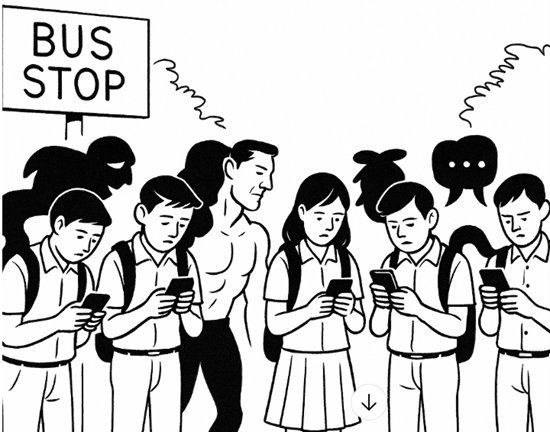

Why the world is finally admitting that social media is unsafe for children
By Ravishankar Kalyanasundaram
For years, parents worried quietly, governments hesitated publicly and tech companies continued confidently. Now the debate is no longer polite. Australia has banned social media for children under 16. Some call it dramatic. In truth, it is overdue. Around the world, societies are realising a difficult truth — childhood cannot survive inside an algorithm built for addiction.
Social media did not enter our lives as a threat. It arrived as a promise. It looked like a global playground without borders — a place where shy children could speak, friendships could flourish and talent could travel farther than neighbourhoods. But unlike a real playground, there were no adults watching. No grandparents offering caution, no teachers setting boundaries, no slow social norms to protect young minds. Instead, the supervisors were algorithms — invisible, tireless and single-minded. Their goal was not safety. Their goal was retention.
Children became the perfect fuel. No group responds more intensely to emotions — joy, jealousy, anger, fear — than teenagers. The more emotional the reaction, the longer the screen time. The longer the screen time, the more the platform wins. Childhood slowly became a battleground of attention.
A decade ago, teenagers spent under three hours a day online. Today, seven hours is common. They do not stay up scrolling because they are undisciplined. They stay up because the system is engineered to keep them awake. What should have been a private period of clumsy self-discovery has turned into a public performance. Counsellors now see children who refuse school after humiliation in a class WhatsApp group. Doctors treat anxiety rooted not in exams, but in comparison with filtered and unrealistic lives. Sleep deprivation in many children is no longer about homework — it is about streaks, badges and endless timelines that spike dopamine on cue
The real heartbreak is invisible. A loud social-media persona can hide a fragile child. The teenager who posts with confidence may cry quietly offline. The question is no longer “Am I liked?” but “Am I likeable enough to be seen?” Growth has been replaced by performance. Innocence replaced by metrics.
Governments did not act because they were ahead of the problem. They acted because the tragedies became impossible to ignore. Country after country began reporting a pattern — children driven to self-harm by content that surfaced not accidentally but algorithmically. Sexual exploitation that spread through encrypted groups. Bullying that never stopped because it followed the child home. Platforms responded with “tools” — teen modes, content filters, parental controls. They sounded reassuring, but they worked like umbrellas in a hurricane. They made the user feel protected, not actually safe.
Then came the discovery that transformed public anger into public action: the founders and executives of major social-media companies did not allow their own children to use the platforms unsupervised. The creators of the digital playground did not believe it was safe for their families. The world saw the hypocrisy, and trust collapsed.
Australia’s ban is not an isolated event. It is the first of many. When one government officially declares that a platform is unsafe for children, others must follow. No leader wants to be the last to protect young citizens.
But bans alone open a new problem. Teenagers migrate. They jump to fringe platforms, anonymous apps and hidden chatrooms. As soon as Australia announced its move, under-16 users began shifting to lesser-known spaces. Some platforms raised their minimum age only after pressure. Others complied only after threats of prohibition. Children have always tested boundaries — the difference now is that the boundary moves with them
So the real crisis is not access. The real crisis is design.
The internet is not the enemy. Phones are not villains. But a commercial platform built to hijack adult self-control cannot magically become safe for a 12-year-old. Children do not yet have the emotional brakes to handle the jackpot-like reward cycles these platforms are engineered to deliver. Expecting a child to self-regulate where adults fail to is not freedom — it is abandonment
This is where India enters the story.
India has the largest young digital population in the world — 250 million children under 16. The scale of vulnerability is unlike anywhere else. In metro schools, counsellors now spend time mediating conflicts born entirely online. In smaller cities and towns, many children encounter adult content before emotional education. The child sitting safely at home behind a locked door is not necessarily protected. In reality, the child may be exposed to more danger than the street outside — only this danger is quiet, invisible and available at midnight.
India has built one of the most sophisticated digital infrastructures in the world — Aadhaar, UPI, digital health, digital identity. Yet there is no comprehensive framework to protect children online. Childhood remains the most unregulated sector of the digital economy. For a country that prides itself on thinking at scale, this is the one scale we cannot ignore
The solution is not to isolate children from technology. Technology is now part of learning, socialising and opportunity. The solution is to return childhood to children.
The right question is not “How do we block platforms?” but “How do we reshape platforms so that children grow, not break, inside them?” A nation that can design digital payments for a billion people can design digital safety for a generation.
History will not judge us by the apps we built or the bandwidth we delivered. It will judge us by whether progress protected those who could not protect themselves. The greatest digital achievement India can build next is not a stack or an ecosystem — it is a world where children are safe not because they are fenced out of danger, but because the digital world has been redesigned to remove it.
When childhood ends inside an algorithm, the question is not what the children are becoming.
The question is what we are becoming.



 Business and Economy
  Education
  Food
Food  Government
  Lifestyle
  Politics
  Travel
  World
World